How to Teach Shapes to Preschoolers With Everyday Objects
Simple, hands-on ways to help preschoolers name, sort and draw basic shapes using things you already have at home, plus games and printable practice ideas.
Shapes are one of the first math ideas young children can actually hold in their hands. A cracker is a square, a plate is a circle, a slice of pizza is a triangle. Before kids learn to add or measure, they're already noticing that some things are round and some have corners. Teaching shapes is mostly about giving that natural curiosity words and structure.
The good news is that you don't need special materials. Your kitchen, your living room and a short walk outside hold enough shapes for weeks of practice. Here's a practical way to build shape knowledge step by step.
Start with four shapes, not ten
It's tempting to introduce everything at once: circle, square, triangle, rectangle, oval, diamond, star, heart, hexagon. For most three-year-olds, that's a lot to keep straight. Start with the big four:
- Circle – round, no corners, no straight sides
- Square – four equal sides, four corners
- Triangle – three sides, three corners
- Rectangle – four sides, two long and two short
Once your child can reliably point to these and name them, add one new shape at a time. Hearts and stars are fun extras because kids love them, and ovals make a nice contrast with circles.
Talk about sides and corners
Naming a shape is a good start, but understanding why it's a triangle is where real learning happens. Use simple language your child can feel with their fingers:
- "Let's count the corners. One, two, three. Three corners means triangle."
- "Run your finger along the edge. Is it straight or curvy?"
- "This one has four sides. Are they all the same length, or are two longer?"
This kind of talk helps kids recognize a triangle even when it's upside down, stretched or tilted. Many children think a triangle only "counts" if it sits flat on its bottom edge, so show them triangles pointing in every direction.
Go on a shape hunt
A shape hunt is one of the easiest activities to set up and one kids ask to repeat. Pick one shape and look for it together around the house.
| Shape | Places to look |
|---|---|
| Circle | Plates, clocks, buttons, jar lids, wheels |
| Square | Crackers, tiles, sticky notes, window panes |
| Triangle | Sandwich halves, roof lines, yield signs, tortilla chips |
| Rectangle | Doors, books, phones, cereal boxes |
For a little extra fun, give your child a clipboard and let them draw a quick sketch of each item they find. Outdoors, look at street signs, windows and wheels on parked bikes.
Build shapes with your hands
Children remember what they make. A few low-prep ideas:
- Craft stick shapes. Lay out craft sticks or straws and build a triangle and a square. Ask how many sticks each one needed.
- Play dough shapes. Roll snakes of dough and bend them into shapes, or press cookie cutters in.
- Body shapes. Lie on the floor with a sibling or parent and make a big triangle or rectangle with your arms and legs.
- Tape shapes on the floor. Make large shapes with painter's tape and have your child walk, hop or drive toy cars along the edges.
These activities also strengthen fine and gross motor skills, which is a nice bonus for this age.
Sort and compare
Sorting turns shape names into real thinking. Gather a pile of mixed items, such as blocks, buttons, paper cutouts or snack crackers, and ask your child to put all the circles in one bowl and all the squares in another.
Then make it a little harder:
- Sort by number of corners instead of shape name.
- Find the biggest and smallest triangle in the pile.
- Ask, "Which one doesn't belong?" when one shape is mixed into a group of another.
Explaining their choices out loud is just as valuable as getting the sort right.
Add puzzles once the basics click
When your child can name the four main shapes confidently, puzzles are a great way to keep practice fresh. Picture sudoku is a natural fit. Instead of numbers, the grid uses shapes, and the goal is to place each shape once in every row, column and box. Our Picture Sudoku with Shapes Worksheet uses a circle, square, triangle and heart on small 4x4 grids, so it's approachable for preschoolers while still making them think.
If your child is new to sudoku, solve the first puzzle together and talk through every move. Our guide on teaching kids the rules of sudoku has a step-by-step approach.
Other printable practice that works well at this stage:
- 2D Geometric Shapes Worksheet for Kids for naming and recognizing shapes
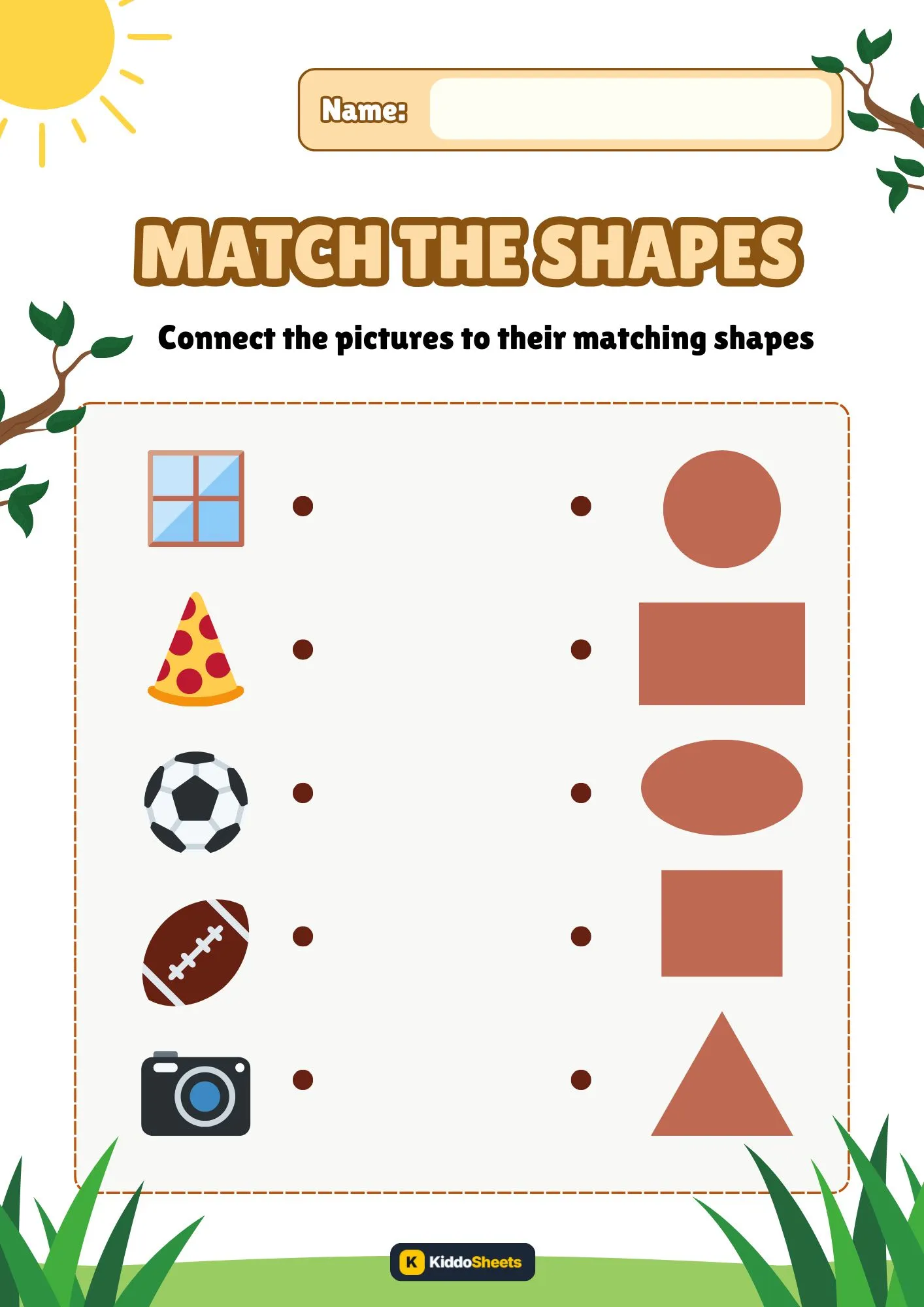
- Match the Shapes With Pictures Worksheet for connecting shapes to real objects
You can browse more in the Shapes worksheet collection.
Draw shapes step by step
Drawing shapes is harder than recognizing them, so be patient. Most children can draw a circle before a square, and a square before a triangle. Diagonal lines take time.
A few tips that help:
- Draw a dot for each corner first, then connect the dots.
- Say the steps out loud: "Down, across, up, back."
- Use thick crayons or chalk, which are easier for small hands to control.
- Praise the effort, not the perfection. A wobbly triangle with three clear corners is a success.
Keep it short and playful
Preschoolers learn best in short bursts. Five or ten minutes of shape play, a few times a week, is plenty. Weave shapes into ordinary moments: cut toast into triangles and ask what shape it is, point out the round moon on an evening walk, or count the corners on a book before bedtime.
If your child seems frustrated, step back to something easier. There's no rush. Shape knowledge builds quietly over time, and every hunt, sort and puzzle adds a little more.
The bottom line
Teaching shapes doesn't need a curriculum. Start with four basic shapes, talk about sides and corners, and use everyday objects for hunts, sorting and building. Once the names stick, add puzzles like picture sudoku and simple drawing practice. Keep sessions short, stay curious, and your preschooler will soon be spotting triangles everywhere you go.